The EU Just Opened the Door to Changing MiCA. Here's What That Means.

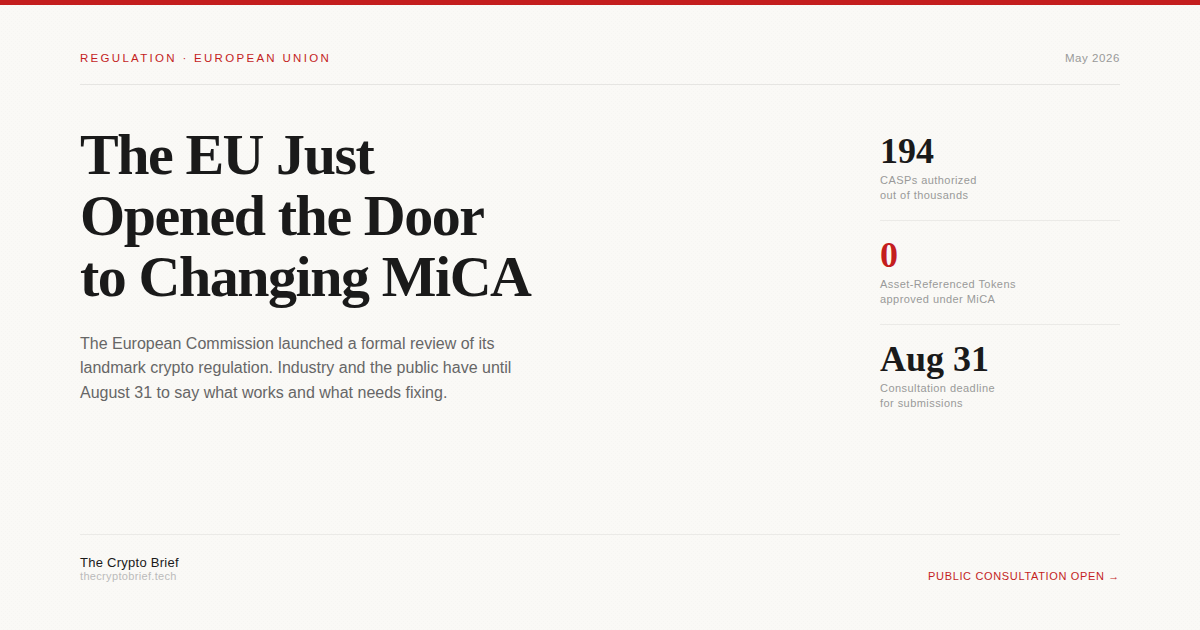
The European Commission launched a public consultation on whether MiCA is still fit for purpose. Submissions close August 31. If you work in crypto in Europe, this is your window.
The Crypto Brief is where I write about MiCA, crypto regulation, and the legal side of building in Europe. If you want to get new articles, subscribe.
Yesterday, the European Commission did something that matters more than most people in the industry realize: it formally opened a consultation to review MiCA.
Not a tweak. Not a technical standard update. A full review of whether the regulation that defines crypto in Europe is still working as intended.
The consultation runs until August 31, 2026. There are two tracks: one for the general public, one targeted at industry participants, regulators, supervisors, central banks, and finance ministries. The responses will feed into a mandated report under Articles 140 and 142 of MiCA. If that report finds gaps, it may come with a legislative proposal to amend the regulation.
In plain language: the EU is asking whether MiCA needs to change, and the answer could actually lead to changes.
Why now?
The timing is not coincidental. Three things are happening at once.
First, the MiCA transitional period ends on July 1, 2026. Every crypto service provider in the EU must have a full CASP license by that date or stop operating. As of May 2026, roughly 194 companies are fully authorized. That's it. Thousands of pre-MiCA registered firms are expected to lose their status. The market is about to contract dramatically, and the Commission wants to know if that's the intended outcome or a sign that something in the framework isn't working.
Second, the stablecoin problem. USDT, the most traded stablecoin globally, is non-compliant under MiCA because Tether has not obtained EU authorization. Exchanges have delisted it for EU users. The result: European traders are moving to offshore platforms to access USDT, which is exactly the opposite of what MiCA was supposed to achieve. Meanwhile, the ART category (asset-referenced tokens) has not cleared a single product. Close to 30 fiat-backed EMTs have been approved, but the broader stablecoin ecosystem is struggling under MiCA's requirements.
Third, the global competition has shifted. The US advanced the GENIUS Act stablecoin bill. Asia is moving fast on its own frameworks. ECB President Lagarde has publicly backed a euro stablecoin response. The Commission is watching other jurisdictions move while EU firms complain about compliance costs pushing activity elsewhere.
The review is the Commission's way of saying: we hear you. Now tell us specifically what's broken.
What the consultation covers
The consultation is broad. It asks whether MiCA remains fit for purpose in light of initial implementation experience and market and policy developments since its entry into application.
Based on the structure and the context, the areas most likely to generate substantive feedback are:
Stablecoin rules. The blanket prohibition on paying interest to EMT holders, the fixed 30% and 60% bank deposit requirements for reserves, and the restrictive HQLA composition rules. Industry players have already argued publicly that these rules make euro stablecoins structurally less competitive than dollar stablecoins issued in other jurisdictions.
CASP authorization. The cost and timeline of authorization. Smaller firms argue that compliance costs (reportedly up to EUR 2 million annually per entity) create a barrier that favors large incumbents and pushes innovation to more flexible jurisdictions.
DeFi treatment. MiCA's potential exclusion for fully decentralized protocols remains one of the hardest open questions. The consultation is likely to attract input on where to draw the line between "decentralized enough" and "centralized enough" to be in scope.
NFTs and unique crypto-assets. MiCA's treatment of NFTs was deliberately left ambiguous. As NFT markets evolve, the question of which NFTs fall under MiCA's scope and which don't needs clearer guidance.
Passporting. The promise of 'one license, 27 countries' is elegant in theory. In practice, NCAs interpret requirements differently, process applications at different speeds, and enforce with different intensity. The consultation may surface whether passporting is actually delivering on its promise.
Environmental disclosure. Every white paper must disclose the energy consumption of the consensus mechanism. The practical implementation of this requirement and its usefulness are fair game for review.
What this means practically
If you're a CASP, issuer, or industry body, this is your formal opportunity to tell the Commission what's working and what isn't. The targeted consultation is specifically designed for you. Don't let it pass without a submission. These consultations directly shape legislation. If the industry stays silent, the next version of MiCA will be written without industry input.
If you're a lawyer or consultant in the space, your clients need to know this is happening. Help them draft submissions. A well-structured response from a CASP that explains, with data, how a specific MiCA provision is creating unintended consequences is exactly what the Commission is looking for.
If you're a founder planning a crypto project in Europe, the review signals that MiCA is not set in stone. The framework will evolve. But don't wait for changes before getting compliant. The current rules are the current rules, and the July 1 deadline is real. Plan for MiCA as it is today, and adapt when (and if) it changes.
If you're just watching from the sidelines, this consultation will tell you a lot about where European crypto regulation is heading. The submissions, once published, will be a roadmap of industry priorities and regulatory pressure points.
What it does not mean
A consultation is not a commitment to change. The Commission is gathering input. It may conclude that MiCA is working fine and needs no changes. It may propose minor technical adjustments. Or it may propose significant amendments. The outcome depends on the evidence it receives and the political appetite for reform.
Don't read "MiCA is being reviewed" as "MiCA is being weakened." The Commission has been clear that this is about targeted improvements, not a reopening of first principles. The core framework (authorization, consumer protection, market integrity) is not on the table. The details of implementation are.
The bigger picture
MiCA was designed in 2022 and finalized in 2023. The crypto market in 2026 looks very different from the one the regulation was written for. Terra/LUNA had just collapsed. FTX was still operating. The US had no federal crypto framework. Stablecoins were a niche product.
Today, stablecoins are a core piece of financial infrastructure. RWA tokenization is accelerating. DeFi has matured. US regulation is taking shape. The question the consultation is really asking is whether a regulation designed for 2023 can serve a market that exists in 2027 and beyond.
The answer will shape European crypto for the next five years.
The consultation is open at ec.europa.eu. Submissions close August 31, 2026.
This article is for informational purposes only and does not constitute legal advice. If you found this useful, I'd appreciate a share. You can find me on LinkedIn and X.
Subscribe to our newsletter.
Be the first to know - subscribe today